Training log - June 28-July 4, 2026: Re-building mileage
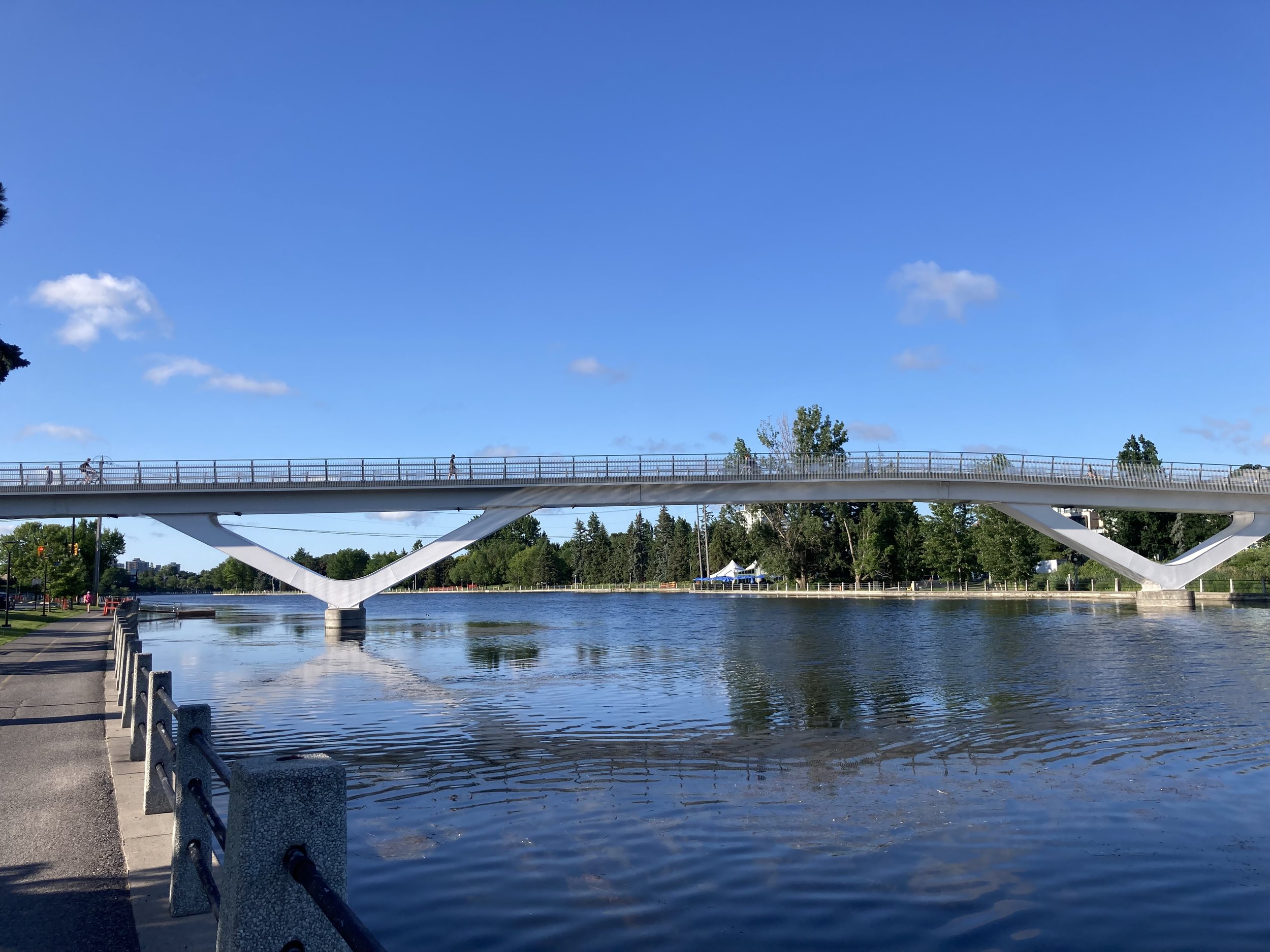
It has been a very long time since I've posted a training log. In fact, it’s been roughly a year. During that time, I still trained, but way less than previously. I overtrained pretty seriously last year, and it took me about 10-11 months to recover (I’ll explain more in a future post).
Now that I am feeling better, I am (once again) in the mileage-building phase. I enjoy it a lot.
Zone 2 training and building mileage.
Here is a summary of how I build mileage.
I spend most of my training time in Zone 2 (roughly 70% of my max heart rate), and I try to keep my heart rate below 120BPM. Ideally, I keep it closer to 110BPM. My pace is pretty slow at this stage: something like 5:50 - 6:00/km at a 110—115 BPM heart rate.
When I am building mileage, I do not care about my pace. Instead, I focus on three things: (1) avoiding injury, (2) staying within Zone 2 to build my aerobic base and become more efficient, and (3) increasing training volume. I train with a chest strap heart rate monitor to ensure that my heart rate is accurate and that I stay within Zone 2.
I err on the side of caution when I run in Zone 2. I prefer to run at the low range of Zone 2 (closer to 105-115 BPM than the upper-range (closer to 115 — 125 BPM). The reason is simple: I want to reap the benefits of low-intensity Zone 2 training and avoid injury as much as possible. The more I drift into Zone 3, the more difficult it is to recover. I do whatever I can to stay in Zone 2 because it is sustainable and generates a very substantial return on investment. Over time, the body becomes more efficient and adapts to the training volume. Running becomes easier over time, and I can run at a similar pace at a lower heart rate. Zone 2 training and aerobic base at the foundation for more intense training.
Zone 2 training and mindset.
During a mileage-building phase, I think a lot about how I want to feel during and after training. I want the runs to feel very easy and relaxed, and I should be able to sustain a conversation while running. Since many days will involve double runs as my mileage increases (one very early in the morning and one in the afternoon), my goal is to finish my first run excited for the second. I do not want to feel tired or destroyed after the first run. My objective is to avoid a common mistake and adage about running: people train too hard on their easy days, and they train too easy on their hard days.
Many mornings, I do not want to run.
So, I play mind games with myself so that I run when I do not fee like it. I tell myself that all I have to do is run down the street. Once I run down the street, I tell myself that all I have to do is run to the next corner. On some days, I do this over and over again throughout the run. I break down 10-12KM runs into small increments. Each time I complete a small increment, it is a success. I achieved something that I would not have achieved if I skipped training. On other days, the run feels better and less effortful, and I do not need to break the run down into smaller chunks. I just run and let my mind drift. I tend to get most of my ideas for academic articles while I run.
I have done endurance training for years, and I know that my feelings can change a lot during a run. As a general rule, I find that the first 5KM or so do not indicate anything. Many days, the first 5KM do not feel great, and after 5KM or so, the run becomes easier. And surprisingly, the second run of the day often feels way easier than the first. The only way to learn these lessons is to do the thing and run. And I try to approach the runs with curiosity and open-mindedness.

Four week training bloc.
Here is a summary of my past four weeks or so of training, which includes June 14 - July 10, 2026.
June 14-20, 2026: 55.6 KM of running mileage with one double run.
June 21-27, 2026: 64.5 KM of running mileage with no double runs.
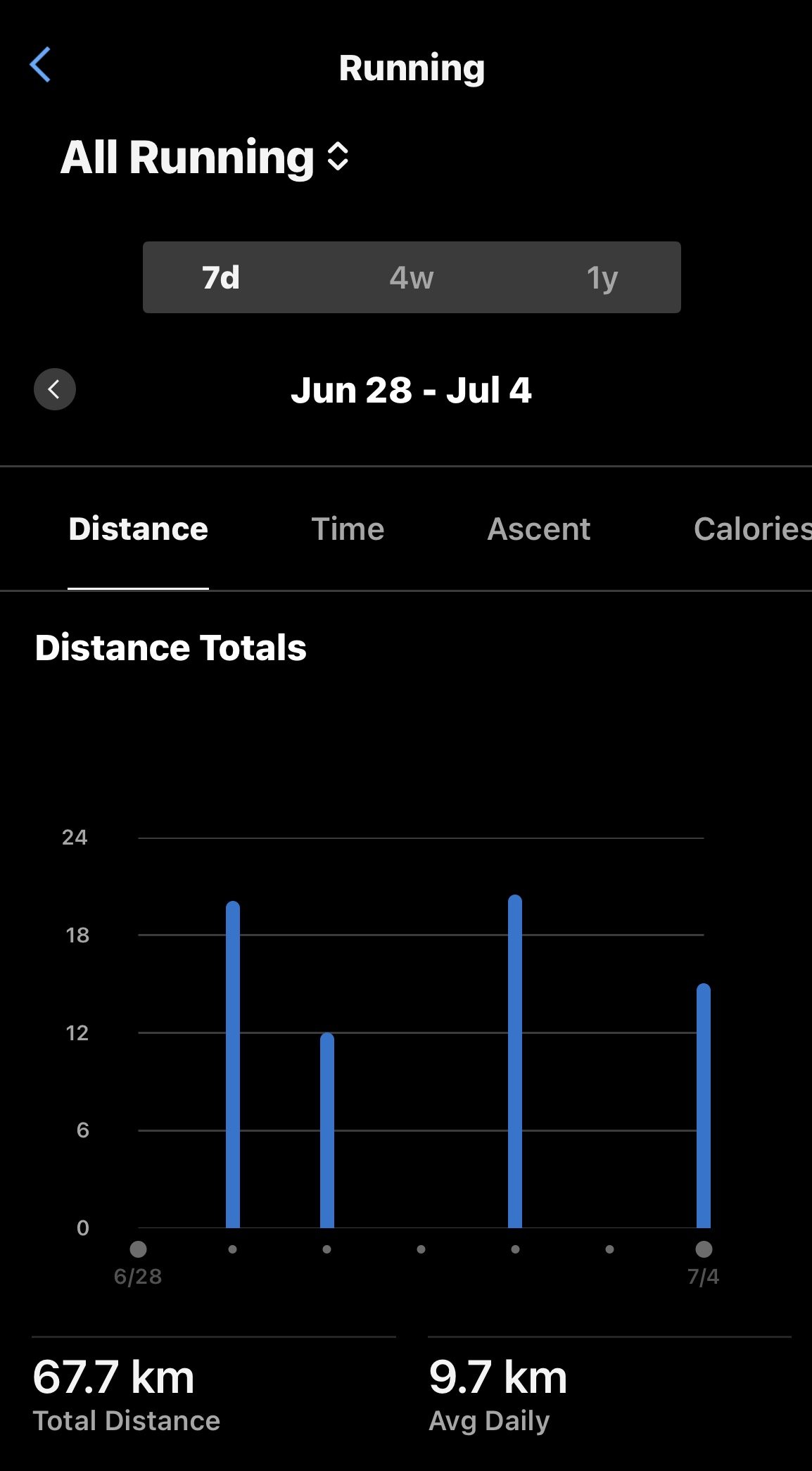
June 28 - July 4, 2026: 67.5 KM of running mileage with two double runs.
July 5 - July 11, 2026 (periodization week)- 22 KM of running mileage. I cut my training volume by 2/3 to ½ during a periodization week so that I clear systemic fatigue, and so that my body can adapt to increased training volume.
I also do 2-3 days of kettlebell training per week. It is great for core strength, especially through rotational exercises. It also helps me build generalized strength, stamina, and balance. Kettlebell training is really interesting because it helps you notice muscular imbalances. It is very obvious when one side of the body is stronger than the other. I find kettlebell training is way less boring than weight training, and allows me to mix cardio with strength/resistance training.
Breakdown of June 28 - July 4 2026 training week.
Here is a breakdown of the training week. I ran roughly 67 KM. All my runs were in Zone 2, and I tried to keep my heart rate close to 110-115 BPM. My pace was slow, and generally between 6:00-6:30/KM.
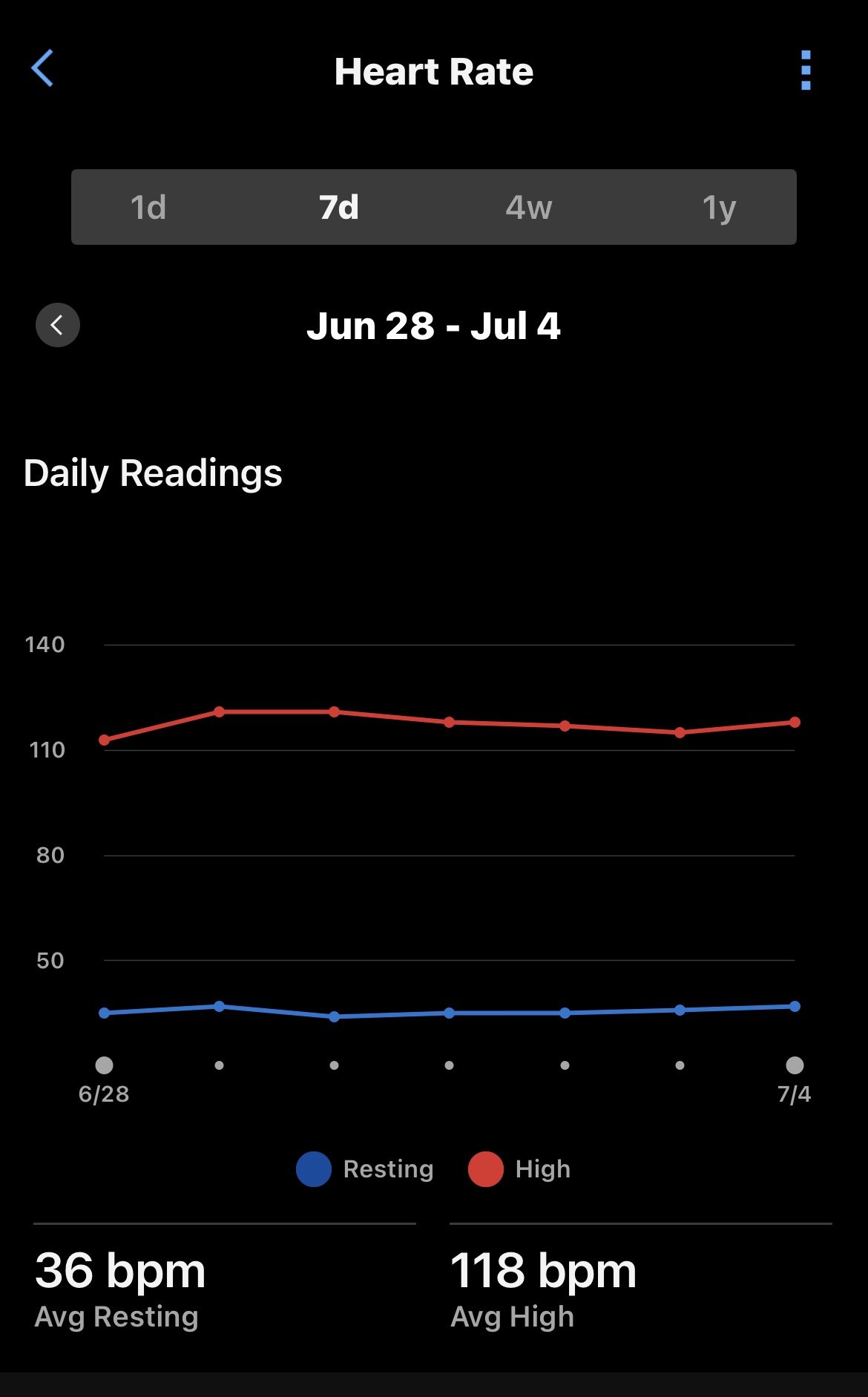
My resting heart rate average was 36 BPM for the week, which is good for me.
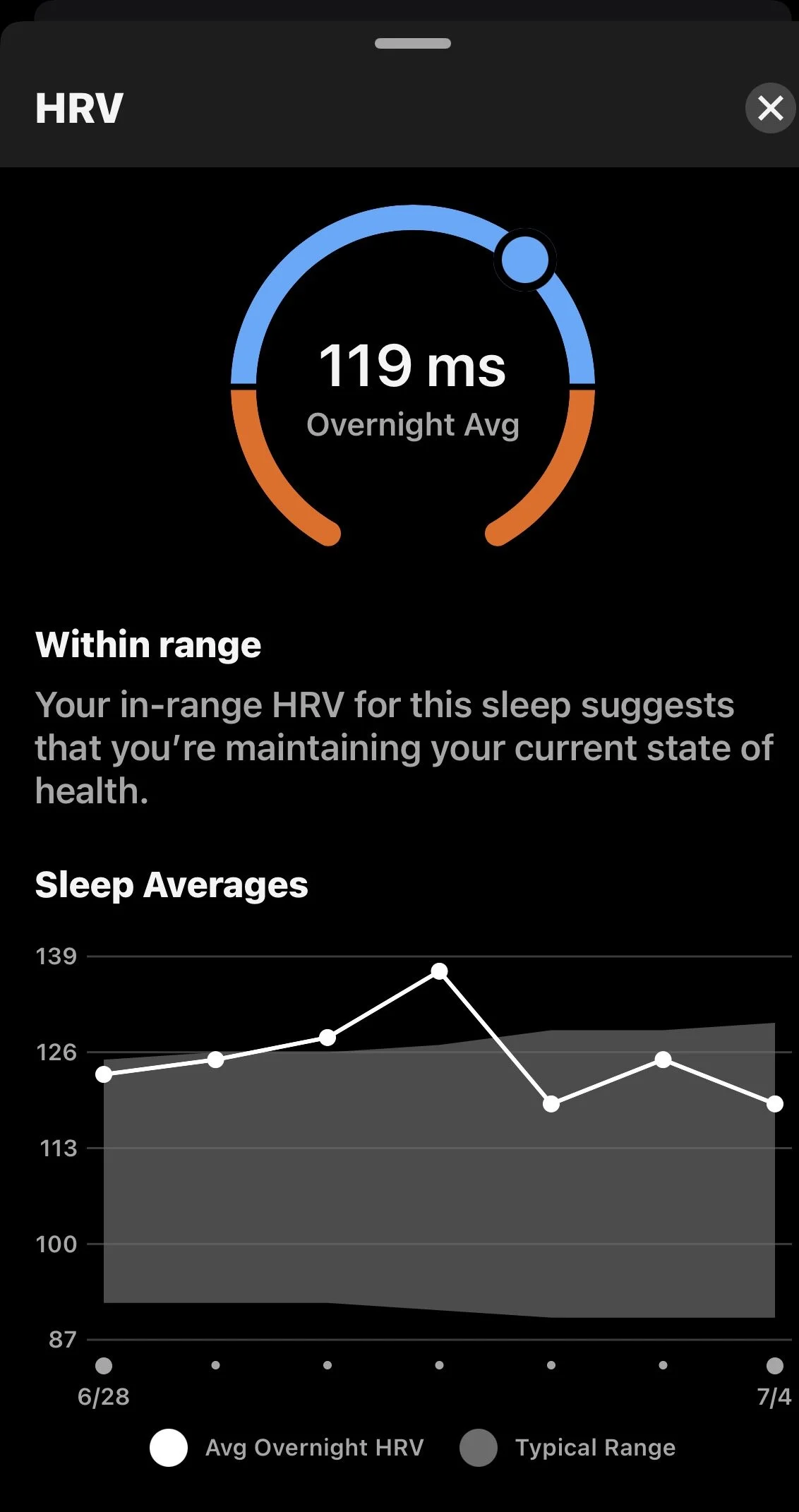
My overnight HRV was closer to 120 ms (my average is somewhere between 100-120ms). My HRV was unbalanced towards the end of the week and spiked a bit, which is a sign that my body needed to recover. Thankfully, it was the last week of my training bloc before periodization (see above).
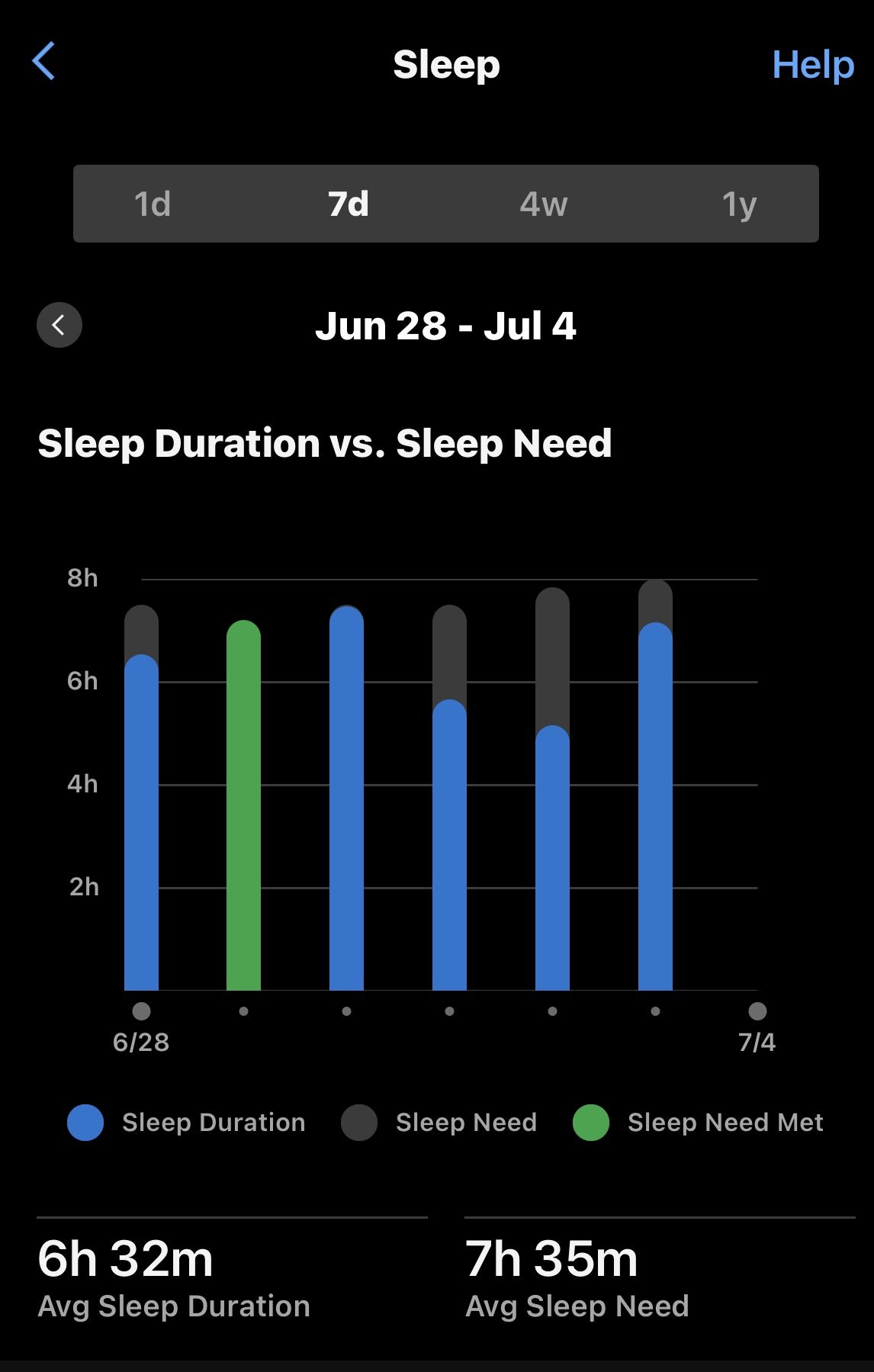
I didn’t sleep well, and averaged close to 6.5 hours per night. My ideal range is 7-7.5 hours per night. I definitely feel it when I sleep under 7 hours, and it’s harder to recover.
Plan for next training bloc
Next training Bloc, my goal is to hit roughly 80KM of weekly mileage by the end of the bloc. I will likely add more double runs to increase my training volume. I try to increase my weekly mileage by roughly 10% per week to avoid injury. When I build volume, I do not do speed sessions or add hills. I only increase one variable so that I do not get injured. Once I’ve attained a high level of weekly mileage, I then build in speed sessions and more hills. One thing at a time.
Have a great week!

All views expressed in this blog are my own and do not constitute any form of medical, nutritional, physiotherapy, or other type of advice.
They do not represent — and are not endorsed by — any academic institution.